The permanent record of fantasy football.
Recordbook turns your league's scattered history into one verified site with your league's name on it. Every game, every lineup, every auction dollar, back as far as the data goes.
Early access · 2026 season
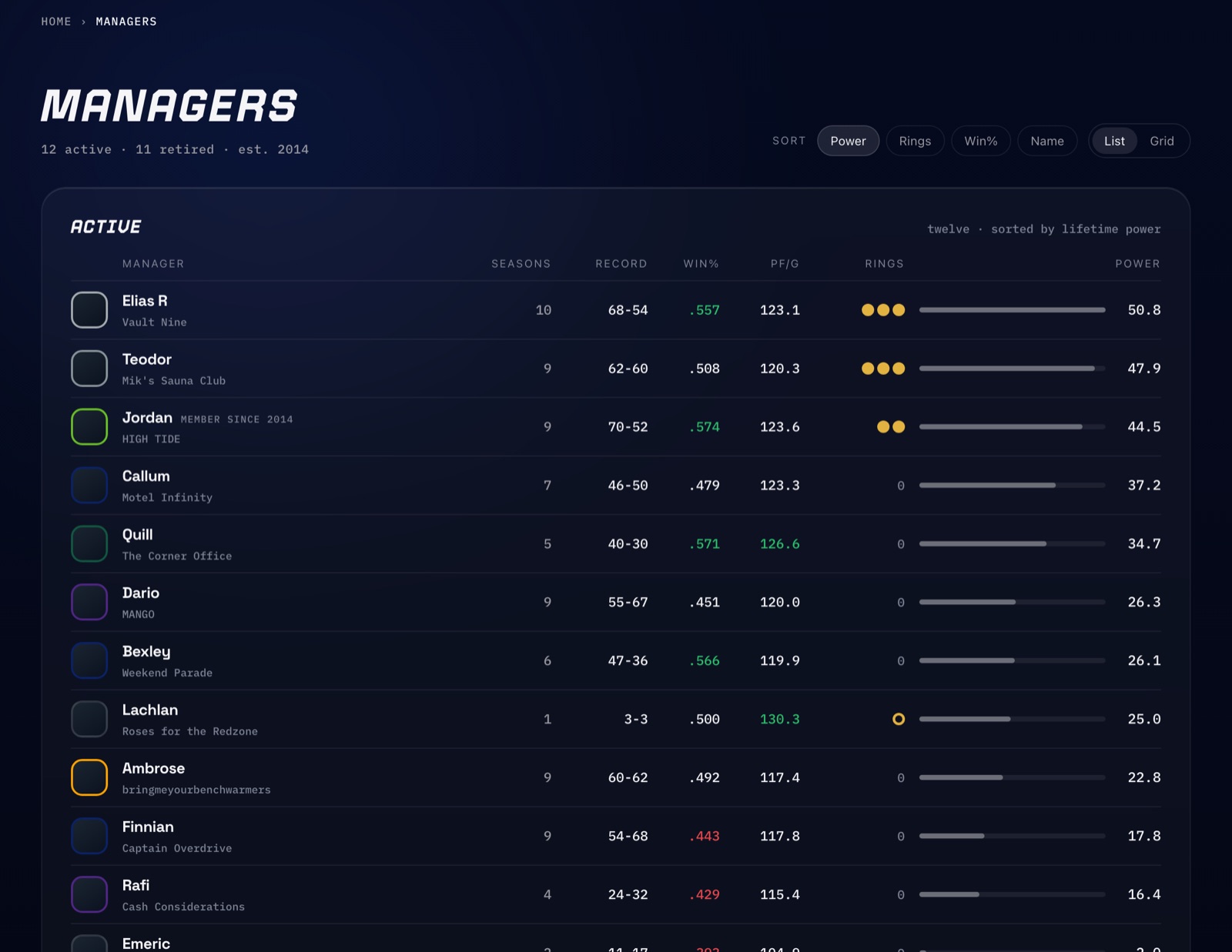
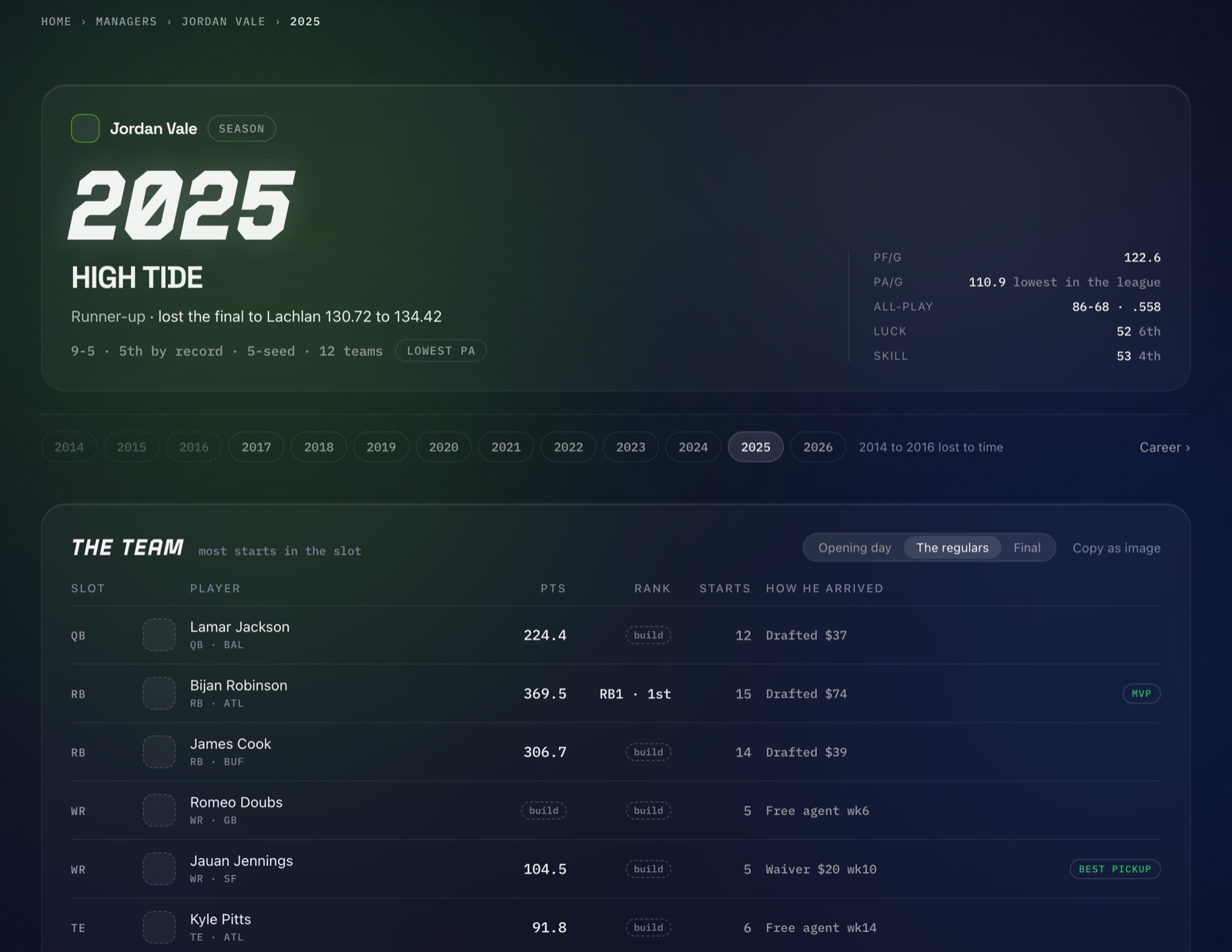
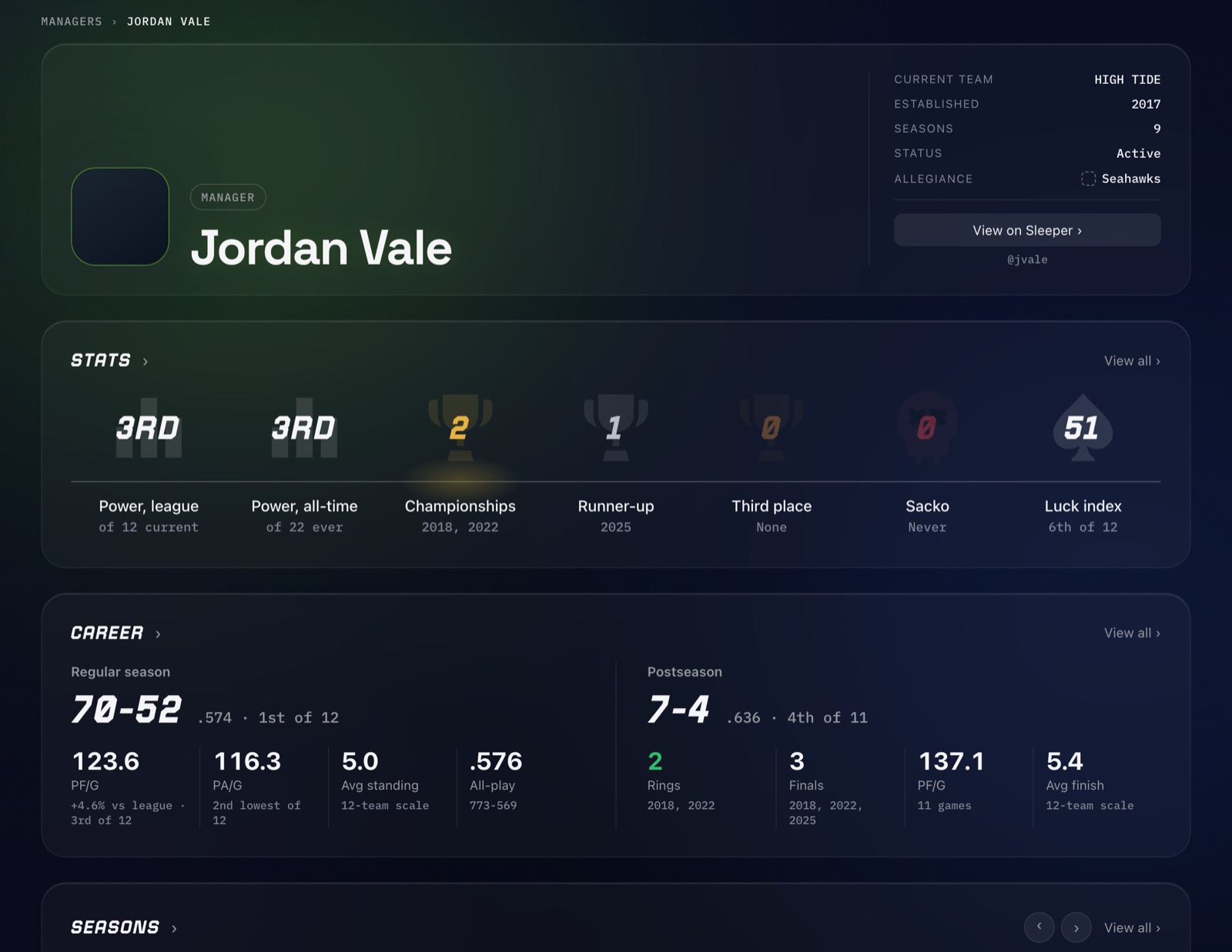
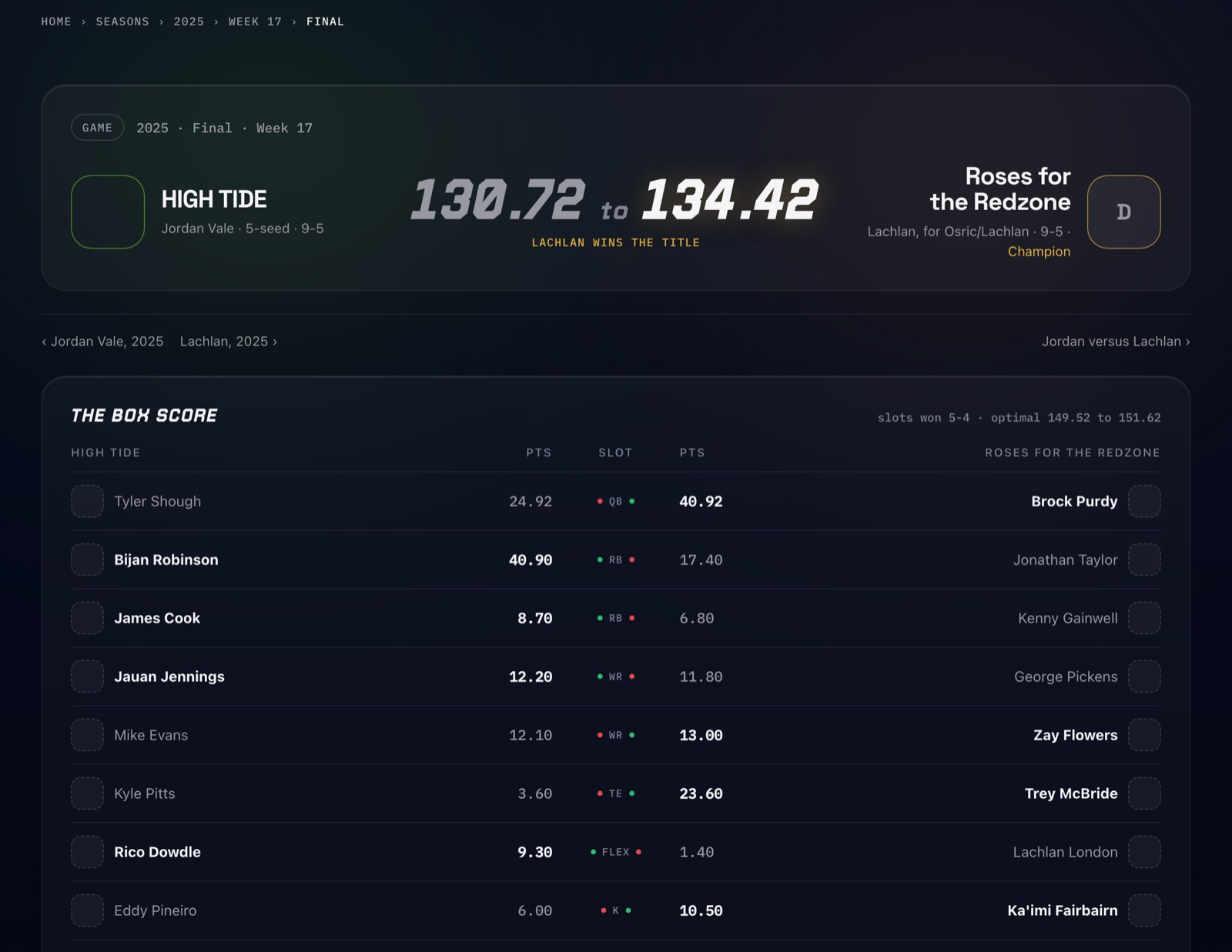
Pages from a live record. Every league gets the same pages.
12kinds of page
1,000+pages per league
4sources
1999NFL statistics since
2,000playoff simulations
The point
View all ›It knows things your league forgot.
Nobody has to write anything. Recordbook reads the data and surfaces what is in it, from the day your league joins. These are real entries from a live record.
71 weeks.
One manager kept the same running back on his roster for 71 weeks and paid to draft him four separate times.
Players › Their guysCorrected †393.84.
The highest raw score in league history included a 280-point extra-point return. The league corrected it to 113.84. The win stands, and the record shows both numbers.
Data notes7 straight.
One head-to-head series runs 8-3 with seven straight wins for the same side. The other manager has not beaten him since the league moved to Sleeper.
Rivalries10-0.
The longest winning streak on record is ten games. Two managers share it, one in 2023 and one across the end of 2024 and the start of 2025.
RecordsReal entries, unchanged.
The pages
Every page ›Every page of the record, for every league.
Twelve kinds of page, the same for every league on Recordbook, in your league's name and colors. Seasons, managers, players, records, rivalries, drafts, moves and tools. A twelve-season league runs to more than a thousand pages.
Your league
Your name on it. Your colors in the light.
Each league gets its own site at its own address, in its own name and colors. Manager pages light in each manager's NFL team colors. Recordbook is one line in the footer.
A template, lit three ways. The pages are real. The name is yours.
What is on a record
- Seasons: standings, results by week, brackets, all-play, the podium.
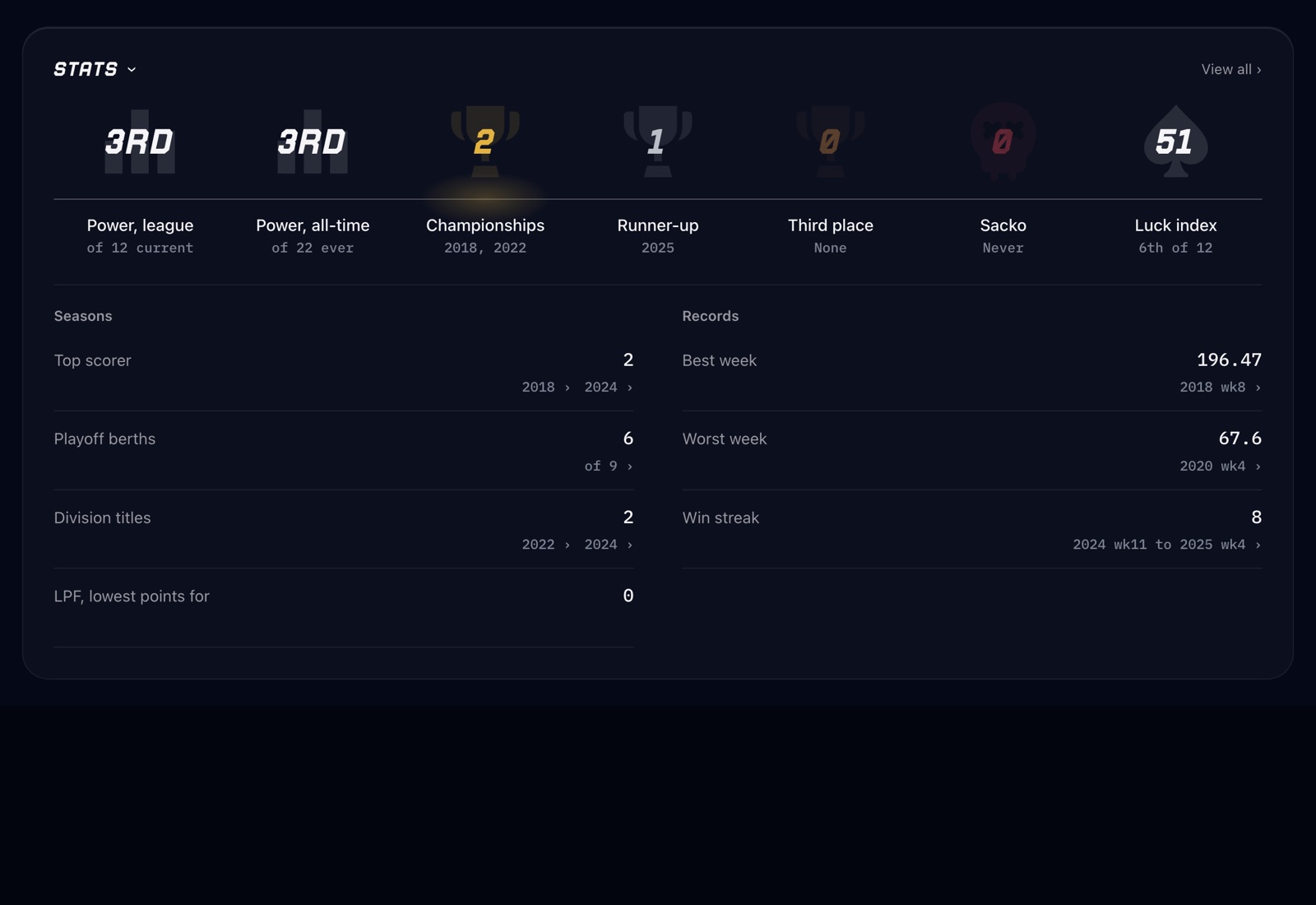
- Managers: an honors shelf, a career ledger, a seasons strip, the Luck Index, the Skill Index, the front office, rivalries.
- Players: every player who ever touched the league, with NFL stat lines and a value chart.
- Records: the record book, lifetime tables, and the original spreadsheet preserved as a page.
- Rivalries: a head-to-head matrix and a page for every pair.
- Drafts and moves: every auction board, every trade graded A to F, every bid.
- Tools: playoff odds from 2,000 simulations, a playoff machine, schedule comparison, power rankings.
Every manager's page has a shelf for championships, runner-ups, division titles, playoff berths and last-place finishes. Empty slots are drawn as outlines, including the one for last place.
The standard
Right, or marked.
Every figure on a Recordbook site is checked against every other source that has it: the platform's records, the league's spreadsheet, the box scores, the brackets. Where sources disagree, the page shows the verified figure with a † and keeps the receipt on a data-notes page anyone can read. One league's spreadsheet had seven bookkeeping errors in twelve years. All seven are still on its page, explained.
877checks
35disagreementsall explained
1,702lineups re-added
0wrong
One league's build, September 2026.
Two of that league's seasons have no surviving data, and a third survives only as the name of its champion.
The record says "lost to time" where the standings would go. It does not guess.
Sources
It starts wherever your history is.
Sleeper leagues connect with an ID. Yahoo history comes back through recovery from the league pages. Spreadsheets get imported. Recordbook reconciles all of it into one timeline: one identity per manager, one scoring rule set per era. When deep history and instant setup conflict, deep history wins.
SleeperLive
Every matchup, lineup, draft, transaction and bracket, back through the league chain.
YahooRecovered
One league's 2017 to 2020 seasons came back this way: 361 games and 722 box scores.
SpreadsheetsImport
Standings, podiums and lifetime tables from a Google Sheet or an Excel file. This is how one league's 2014 to 2020 seasons got on the record.
NFL statisticsLive
Stats, rosters, injuries and schedules back to 1999, for every player who ever touched your league.
ESPNPlanned
Say so when you request access. Leagues with ESPN history move the queue.
NFL.comArtifacts only
The platform is gone. An old email with a league link can unlock archived snapshots.
In season
Every Tuesday, the record catches up.
Data syncs after the week's last game. By Tuesday morning the season page, every manager page, the playoff odds and the power rankings are current, with nobody lifting a finger. Two pieces ship during the 2026 season: the weekly drop, a recap by email that is formatted to paste into the group chat, and the vote, where the league ranks its own power rankings against the algorithm's. No accounts. You pick your name from the list.
Refresh LiveWeekly drop This seasonThe vote This season
The desk
Writers you can turn off.
Recordbook works with no writing at all. The archive, the records, the tools and the votes stand on their own. The desk is a layer on top: a rotating crew of beat writers who file a recap and storylines from the week's data, each with a different temperament, so a league develops favorites and villains. The commissioner sets the tone, from friendly to savage. Every sentence has to trace to a fact in the record before it runs. No invented quotes, no imagined group-chat reactions. Any league can switch the desk off.
This seasonHow the writing works ›
Start your league's record.
Recordbook is in early access for the 2026 season. Founding leagues are being onboarded now. Tell us where your league lives and we will tell you what we can recover.
Start your league's recordEarly access · 2026 seasonQuestions.
Do we have to change platforms?
No. Recordbook reads your platform. You keep playing where you play.
Does anyone need an account?
No. Pages are public to anyone with the link, like a record should be. Votes use a pick-your-name list. A private option is on the roadmap.
Our history is in a spreadsheet.
Send it. Spreadsheet import is how one league's 2014 to 2020 seasons got on the record.
We changed platforms twice.
So has a league on Recordbook: NFL.com, then Yahoo, then Sleeper. One identity per manager carries across all of them, including name changes.
What does it cost?
Nothing for founding leagues through the 2026 season. Per-league pricing comes after that, published before it applies to anyone.
Can we take our data with us?
Yes. Your record is a static site built from data you can export as JSON at any time.
What about other sports?
Football only for now.